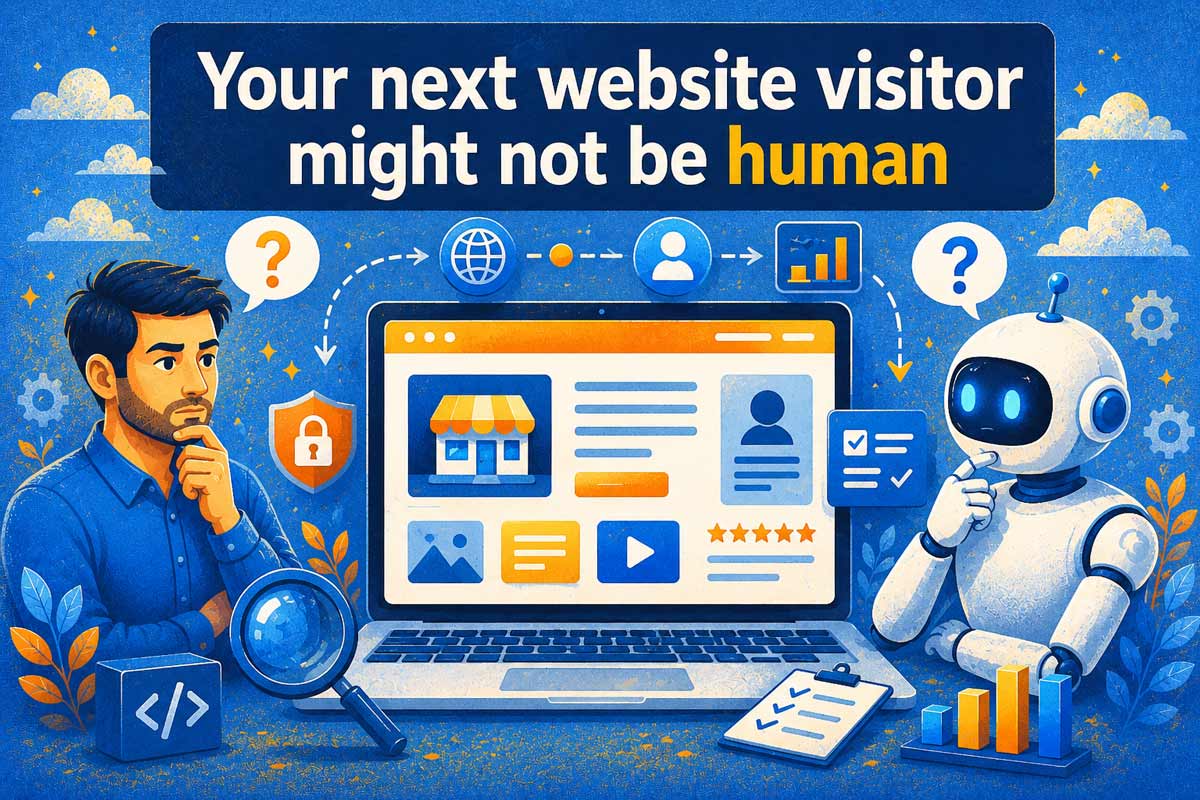
Your Next Website Visitor Might Not Be Human
AI is beginning to browse, interpret, and compare businesses on our behalf. That changes what a good website needs to do.
For decades, websites have been designed around one assumption: a person is on the other side of the screen.
We think about where they will look, what they will click, how quickly they will understand a message, and what might convince them to take the next step. Entire disciplines like UX and conversion optimization have been built around understanding that human journey.
But your next website visitor might not be human at all.
Artificial intelligence is moving beyond simply answering questions with information it already has. AI agents can increasingly browse websites, gather information, compare options, and complete tasks on behalf of people. A potential customer may eventually ask an AI assistant to find a service, compare several businesses, recommend the best option, and perhaps even initiate the next step.
The person may never visit all of those websites themselves.
From the user journey to the agent journey
This creates an interesting new challenge for businesses.
Imagine someone looking for an interior designer, cleaning company, medical practice, contractor, or marketing agency. Instead of opening ten browser tabs and comparing businesses manually, they ask an AI assistant to do the research.
The AI us the one who visits and scans those websites for the user
It is trying to determine some of the same things a human would: What does this company actually do? Where does it operate? Who does it serve? What makes it different? Is there evidence that it is credible? How can someone get started?
Suddenly, all the things that make a website clear become even more important.
Beautiful design still matters to the human who eventually sees the site. But an AI agent may care much more about whether the information behind that design is understandable and accessible.
A beautiful website can still be difficult to understand
This is where some existing websites may run into trouble.
Businesses often rely heavily on visual storytelling, clever headlines, broad marketing statements, or information that is implied rather than stated.
A person might be able to piece everything together. A machine may not.
“Building possibilities together” might sound good on a homepage, but it does not explain whether the company builds houses, software, brands, or financial portfolios.
Clear service descriptions, meaningful headings, logical page structure, accessible content, location information, testimonials, credentials, and straightforward explanations all provide context that both humans and machines can understand.
This does not mean websites should become boring or robotic. It means creativity needs a clear foundation.
Designing for AI may actually mean designing better for people
There is an interesting irony here. Many of the things that make a website easier for artificial intelligence to understand also make it better for humans.
Clear navigation helps both. Good information architecture helps both. Descriptive headings help both. Useful content helps both. Accessibility helps both.
And perhaps most importantly, specificity helps both.
A business that clearly explains what it does, who it helps, where it operates, and why its approach is different gives a human visitor confidence. It also gives an AI system better information to work with.
So preparing a website for AI does not necessarily mean adding another layer of technology. In many cases, it means removing ambiguity.
Your website may need to sell without being seen
This may be the biggest change of all.
We have traditionally thought of a website as the place where a business makes its case. The customer arrives, experiences the brand, reads the content, looks at the work, and decides whether to make contact.
AI introduces another possibility: your website may need to make part of that case to a machine first.
That machine could determine whether your business is included in a comparison, mentioned in an answer, or recommended as an option before the potential customer ever sees your homepage.
That does not make design, branding, or the human experience less important. It makes the information underneath them more important.
The takeaway
The next evolution of web design may not be about choosing between designing for people and designing for artificial intelligence. The best websites will need to communicate effectively with both.
We have spent years thinking carefully about the user journey. Now it may be time to start thinking about the agent journey too.
And fortunately, the fundamentals are surprisingly familiar: be clear, be useful, be credible, and make your business easy to understand.
Start a strategy conversation