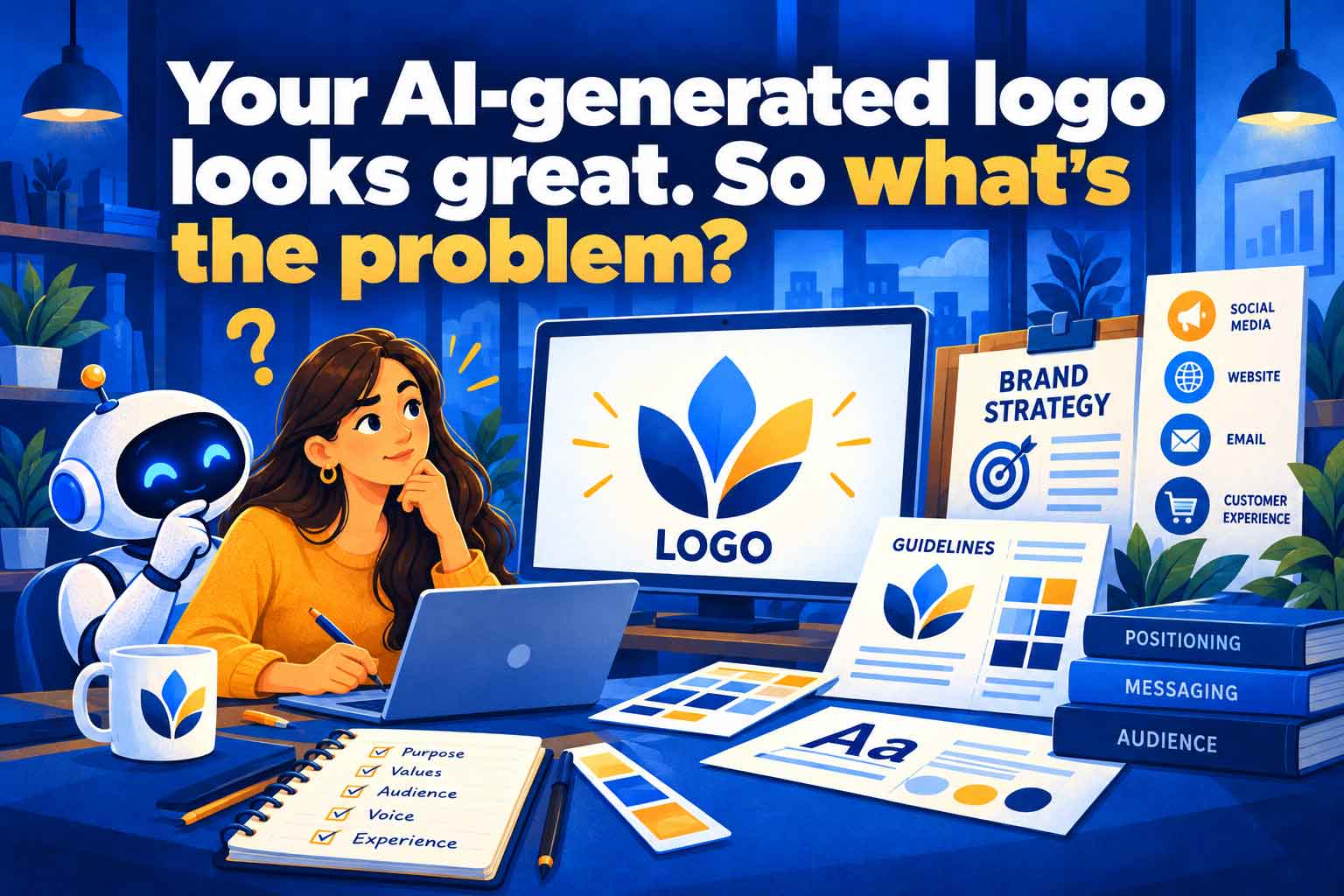
Your AI-generated logo looks great. So what's the problem?
AI can create a convincing design in seconds. But knowing what to ask, what to look for, and what comes next is where experience makes the difference.
You asked AI to design a logo for your business. Thirty seconds later, you have something that looks surprisingly professional. The colors work, the typography looks modern, and you can already picture it on your website.
So what's the problem?
Maybe nothing. But here's a question worth asking: How do you know it's the right logo?
A design can look impressive without communicating anything meaningful about the business behind it. And when AI generates something visually appealing, it's easy to mistake a convincing result for a well-considered decision.
That's where the difference between generating a logo and building a brand begins.
What AI doesn't know about your business
Imagine asking an AI tool to design a modern logo for a roofing company. Within seconds, it might generate several attractive options featuring rooftops, bold typography, and familiar industry symbols.
Some might even look professional.
But what does the AI actually know about that company? Does it understand whether the business specializes in luxury residential roofing or large commercial projects? Does it know the company's reputation, its competitors, its long-term ambitions, or the kind of customers it wants to attract?
Unless that information has been provided, the AI is working with assumptions and familiar visual patterns rather than a meaningful understanding of the business.
And this is where things get interesting. The problem isn't necessarily the technology or even the quality of the image it produces. It's the absence of a strategic foundation.
A business owner might see an attractive logo and feel that the job is done. An experienced creative director sees the same image and starts asking questions. Does this communicate the right personality? Is it distinctive? Does it appeal to the intended audience? Will it still make sense as the business grows?
The difference is not simply having a better eye for design. It's understanding what the design needs to accomplish.
The questions behind the design
Professional branding is not a single creative exercise. It's a progression of decisions, each one informing the next.
Before exploring visual directions, an experienced creative director works to understand the business itself. What does it stand for? What makes it different? How do customers perceive it today, and how should they perceive it tomorrow?
These questions aren't just part of a discovery meeting. They become the foundation for everything that follows.
And this is where AI can become an incredibly powerful tool.
Rather than asking it to produce a finished logo immediately, a creative director can guide AI through a series of focused explorations. It might begin with understanding the competitive landscape, move into conceptual territories, explore different visual personalities, and eventually help visualize how promising directions could translate into a complete identity.
Each stage builds on the decisions made before it.
Sometimes AI produces something unexpected that opens an entirely new creative direction. Sometimes it generates an attractive idea that doesn't align with the strategy. Knowing the difference is part of the job.
The ability to ask better questions matters, but knowing when to ask them is equally important. Asking AI to generate a logo before defining the brand is a little like asking an architect to design a house before discussing who will live in it.
You might get something beautiful. That doesn't mean it's the right solution.
The real expertise isn't simply knowing how to prompt AI. It's knowing how to direct a creative process.
A logo has to live somewhere
A logo rarely exists on its own. It becomes part of a much larger visual ecosystem that includes your website, business cards, signage, uniforms, vehicles, social media, packaging, advertising, and countless other customer touchpoints.
And this is where the difference between a good-looking image and a functional brand identity becomes obvious.
A logo might look impressive on a screen but lose its character when embroidered on a shirt. It might work beautifully against a dark background but become difficult to recognize in a small social media profile. Its typography might feel sophisticated in isolation but clash with everything else the business needs to communicate.
There are also questions of originality, reproduction, consistency, and whether the final artwork can be delivered in the professional formats needed for printing and digital applications.
Imagine investing in a new website, vehicle graphics, uniforms, and marketing materials around a logo you generated in a few minutes. Six months later, you realize it looks almost identical to several competitors, doesn't reflect the quality of your services, or appeals to the wrong audience.
Suddenly, that free logo doesn't feel quite so free.
An experienced designer anticipates these possibilities before they become expensive problems. They don't simply evaluate whether a logo looks good. They consider how it will function, how it will evolve, and how it connects to the rest of the brand.
Typography, color, imagery, graphic elements, layout principles, and messaging all need to work together. A strong identity isn't a collection of individually attractive pieces. It's a recognizable visual language.
You can see how this thinking translates into real-world applications through our branding and design work.
The difference is who's directing it
There's a tendency to frame AI and professional designers as opposing forces, as though businesses must choose between embracing technology and investing in creative expertise.
But that's not necessarily the choice.
AI can make an experienced designer considerably more effective. It can accelerate research, expand creative exploration, help visualize concepts, and make it easier to test ideas across different applications before committing to a final direction.
What previously required days of preliminary visualization might now be explored in hours. That efficiency can create more room for experimentation, strategic thinking, and refinement.
But faster production doesn't automatically mean better decisions.
A creative director still needs to recognize which ideas are worth pursuing, understand why something works, identify where it falls short, and determine how to turn a promising concept into a coherent brand system.
They also need to know when AI isn't the appropriate tool. Precision typography, original vector artwork, technical production requirements, and final quality control often demand traditional design expertise and careful hands-on execution.
At Tactic Pixel, we see emerging technologies as an extension of the creative process, not a replacement for the experience behind it. The opportunity is to combine the speed and possibilities of AI with the strategic thinking, design knowledge, and judgment developed through years of professional creative work.
And perhaps that's the most important distinction for business owners to understand.
You're not simply hiring someone who knows how to use design software or write sophisticated AI prompts. You're investing in someone who understands how to translate your business into a recognizable identity, and who can guide the process from the first conversation to the final application.
AI can help create more possibilities than ever before. Experience helps determine which possibility is worth building a business around.
The takeaway
Artificial intelligence has made professional-looking design more accessible than ever, and that's a positive development. For some businesses, an AI-generated logo may be a perfectly reasonable starting point.
But as a business grows, the expectations placed on its identity grow with it.
A brand needs to communicate clearly, distinguish itself from competitors, work consistently across different environments, and represent the business behind it. Getting there requires more than a compelling image or a clever prompt.
It requires understanding the business, asking the right questions, making decisions in the right order, and knowing how every element contributes to the larger picture.
The real question isn't whether AI can create a beautiful logo. It clearly can.
The question is whether that logo is the right foundation for your business.
AI is the tool. Creative direction is what gives it purpose.
Start a strategy conversation