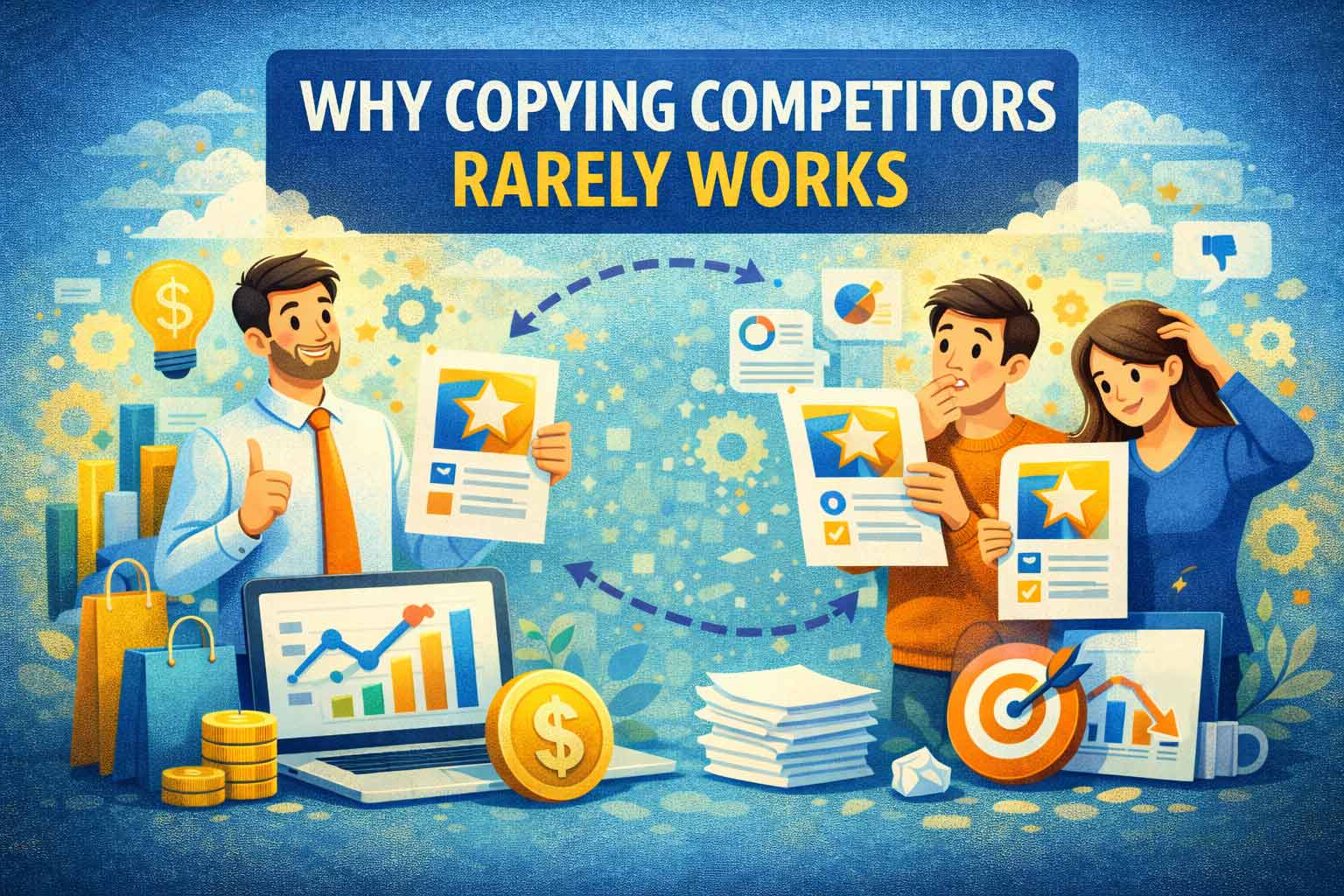
Why copying competitors rarely works
When you are running a small business, it is natural to look at competitors for guidance. You see a website that looks polished or a brand that feels established and think, “We should do something like that.” It feels safe. It feels proven. And when time or budget is tight, copying what already exists can feel like the quickest path forward. The problem is that it rarely works the way people expect.
You only see the surface, not the strategy
When you look at a competitor’s website or marketing, you are only seeing the final layer. You do not see the strategy behind it, the decisions they debated, or the tradeoffs they made. You also do not know what is actually driving their results, or whether those results even come from the website at all.
What works for one business is usually shaped by their audience, their history, and their specific goals. When those same ideas are copied without context, the result often looks familiar but does not perform.
Blending in is the bigger risk
As more businesses in the same space copy one another, everything starts to look the same. Similar colors. Similar language. Similar promises. From a customer’s point of view, the options blur together.
When businesses feel interchangeable, decisions often come down to price or convenience. That is rarely where small businesses want to compete.
Even in crowded markets, no two businesses are exactly alike. Differences in approach, experience, personality, and focus matter more than they might seem. When branding and messaging reflect those real differences, they feel more authentic and easier to trust.
That kind of clarity is difficult to imitate.
This does not mean competitors should be ignored entirely. Looking at the market can be useful for understanding expectations and avoiding obvious mistakes. The issue is when competitor research becomes the starting point instead of a reference point.
A more helpful question is, “What does our customer need to understand quickly in order to choose us?”
When a website or brand answers that clearly, it does not need to look like anyone else’s. It just needs to make sense.
The takeaway
Copying competitors can feel like a shortcut, but it often leads to generic results. Clear thinking and intention are what help small businesses stand out and grow with confidence.
If you are unsure how to differentiate your business without overcomplicating things, a short conversation can help bring that clarity.
Start a strategy conversation