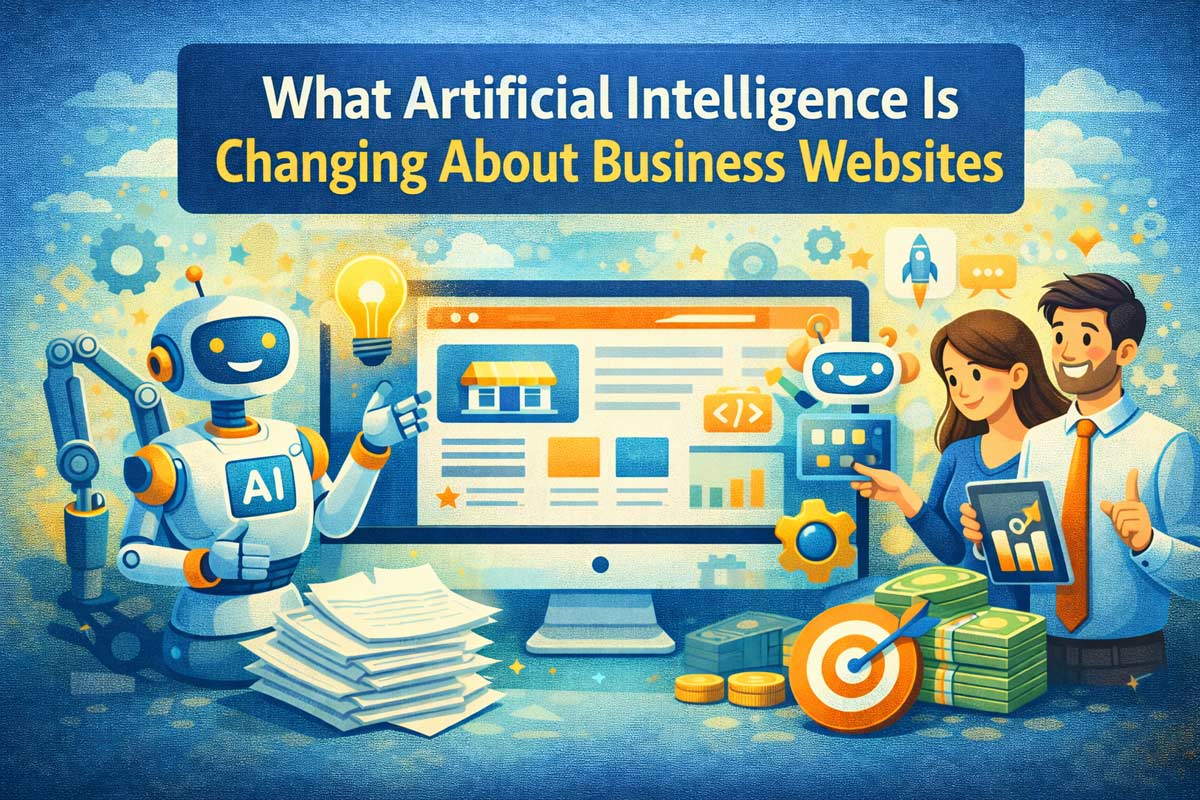
What artificial intelligence is changing about business websites
For a long time, business websites were built as destinations. You drove traffic to them, presented your services, and hoped visitors would spend enough time exploring to understand what you offered. Artificial intelligence (AI) is changing that dynamic.
Today, people increasingly receive answers before they ever reach a website. Search results summarize. AI tools explain. Voice assistants respond. In many cases, a website is no longer the place where understanding begins. It is the source being interpreted somewhere else. That shift is subtle, but it has real consequences for how business websites perform.
Most existing websites were not built to answer questions. They were built to describe services. There is nothing inherently wrong with that, but it creates friction in a world where platforms are trying to extract clear, direct meaning. Pages often talk around a topic instead of addressing it. Copy is polished but vague. Headings are designed to look good rather than communicate clearly. To a human skimming quickly, this can feel frustrating. To an AI system trying to understand intent, it becomes difficult to use.
What artificial intelligence is changing is not just how content is delivered, but what gets rewarded. Pages that explain something clearly, step by step, are becoming more valuable than pages that simply promote. Structure matters. Language matters. Intent matters. Content that helps someone understand a question quickly is easier to summarize, reference, and reuse. This is why some businesses feel like their website should be working, but quietly isn’t. The design may be strong and the SEO technically sound, yet the site is still hard to interpret in an answer-driven environment.
This is often where conversations about AEO begin, but the real issue runs deeper than terminology. You do not need to optimize for artificial intelligence as a trend. You need to make your expertise easier to recognize. That usually means revisiting how information is organized, how headings guide meaning, and whether pages actually answer the questions people are asking. In many cases, this is not about adding more content. It is about removing ambiguity.
For existing business websites, this shift can feel uncomfortable because it challenges assumptions. A site can be well-designed, on-brand, and fully optimized, and still struggle to communicate clearly enough to be used as a reference point. That does not mean the site failed. It means it was built for a different version of the web. Artificial intelligence is exposing those gaps, not creating them.
A practical way to think about this is simple. If your website helps a human understand something quickly, it will usually help machines do the same. If it relies on implication, abstraction, or marketing language alone, it will struggle as answers become more automated. Good SEO helps your site get indexed. Clear thinking helps your site get understood.
The takeaway
Artificial intelligence is changing how business websites are interpreted, by both machines and humans, not just how they are found. Websites that prioritize clear, high-quality content, structure, and intent will age better than those built only to attract clicks.
If you are unsure whether your website is built to explain rather than simply present, a short strategy conversation can help clarify what deserves attention for your specific business.
Start a strategy conversation